- Oasis center Princess cars building - 1st Floor - Unit 13-14 Sheikh Zayed Rd - Al Quoz - Al Quoz 1 - Dubai
- info@secureverse.ae
Secureverse Leading Interior Design and Fit-Out Company In UAE

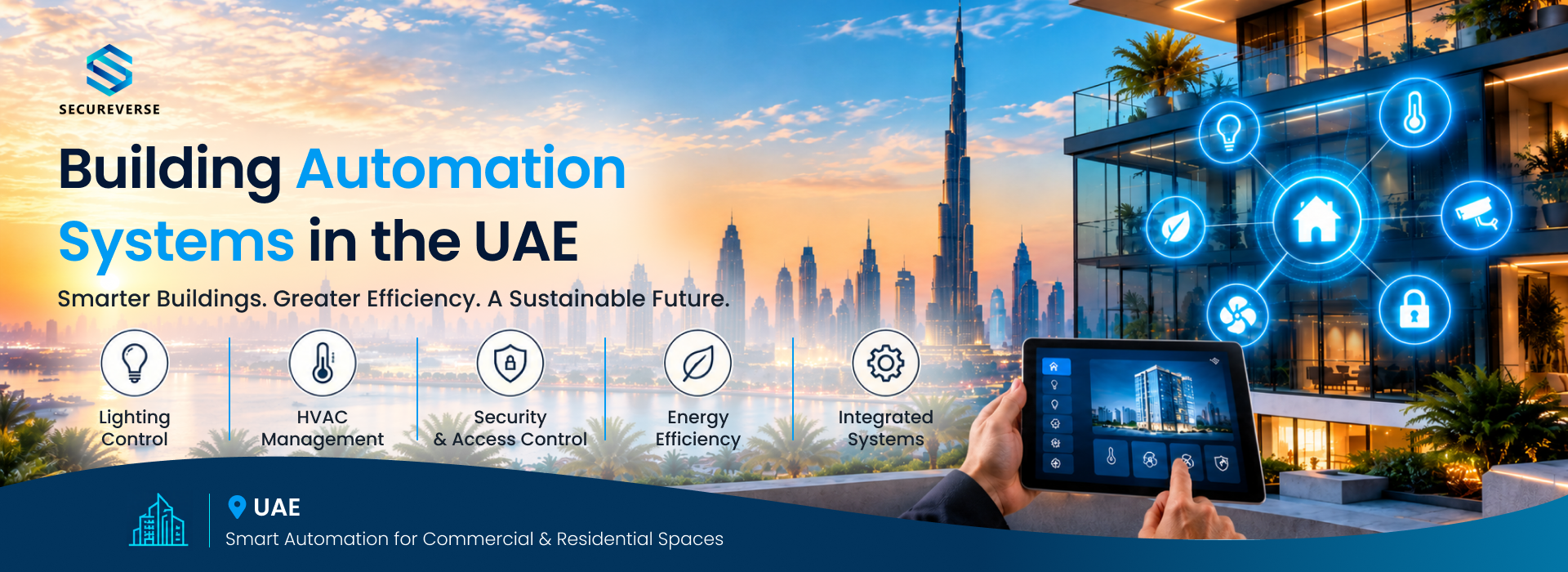
Buildings across the UAE are becoming increasingly connected. Offices, residential developments, retail spaces, hotels, and commercial facilities rely on multiple systems to maintain indoor comfort, support security, and keep daily operations running smoothly.
Managing these systems separately can make monitoring and coordination more complicated. Building automation systems help address this challenge by connecting selected building services through sensors, controllers, software, and communication networks.
For example, a building automation system may help a facility manager monitor HVAC equipment, manage lighting schedules, receive alerts about selected operating conditions, and review information through a central dashboard.
However, successful automation involves more than installing connected devices. The system must suit the building’s operational needs, work with compatible equipment, and be integrated into the physical environment.
Building automation systems are technology platforms that monitor and control selected building services, such as HVAC, lighting, and compatible equipment, using sensors, controllers, software, and communication networks.
A building may contain multiple systems that operate independently. A building automation system can bring selected functions together so authorised users can monitor or manage them through a coordinated interface.
Depending on the installation, a BAS may include:
The exact capabilities depend on the building, installed equipment, control platform, and project scope.
A small office may need basic scheduling and monitoring, while a larger commercial facility may require more extensive controls across multiple areas.
Building automation systems can help property owners and facility managers in the UAE coordinate building services, monitor equipment, support indoor comfort, and manage selected operations through centralised controls.
The UAE’s climate, building diversity, and operational requirements make careful management of indoor environments important. Cooling systems, lighting, and other building services need to operate according to the property’s use and requirements.
Building automation can support this process in several ways.
A central dashboard can provide information about the status of connected equipment. This can help facility teams identify certain operating conditions without checking each system individually.
Configured temperature controls, lighting schedules, and compatible sensors can help maintain selected environmental settings according to occupancy and operating requirements.
Automation can help operators review equipment status and receive notifications when configured conditions occur.
Where systems are compatible, automation can provide a common interface for selected functions that would otherwise be managed separately.
Schedules, monitoring, and control strategies can help operators understand energy-use patterns and identify opportunities to review how building services operate. Actual energy savings depend on the equipment, building conditions, settings, and operational practices.
The functions included in a building automation system depend on the property’s needs and existing infrastructure.
| Building System | Potential Function |
| HVAC | Temperature control, schedules, equipment monitoring |
| Lighting | Scheduled switching and compatible lighting controls |
| Environmental Sensors | Monitoring temperature, humidity, or other selected conditions |
| Equipment Monitoring | Viewing the status of supported equipment |
| Energy Monitoring | Tracking selected energy-use information |
| Access Control | Integration with compatible entry systems |
| Alarms | Notifications about configured faults or operating conditions |
| Central Dashboard | Viewing information from connected systems |
| Residential Automation | Coordinating compatible home automation functions |
Not every property needs every feature. A residential building, hotel, warehouse, and office have different operational priorities.
The best system is one designed around the actual requirements of the building.
A building automation system collects information from sensors and connected equipment, processes it through controllers or software, and uses configured rules or commands to monitor or adjust supported building functions.
For example, a temperature sensor may report that a room has moved outside its configured temperature range. Depending on the system design, the controller may adjust a compatible HVAC function or notify an authorised operator.
Similarly, a lighting system may follow a defined schedule or respond to occupancy information when suitable sensors and controls are installed.
The basic process involves five stages:
The system’s capabilities depend on correct configuration, equipment compatibility, and the control strategy selected for the building.
Building automation generally focuses on managing services and equipment across commercial or larger properties, while home automation typically focuses on residential convenience, including lighting, curtains, entertainment, and climate controls.
| Feature | Building Automation | Home Automation |
| Typical Environment | Offices, hotels, commercial facilities | Apartments, villas, residential properties |
| Primary Objective | Building operations and equipment monitoring | Convenience, comfort, and residential control |
| Common Systems | HVAC, lighting, equipment monitoring | Lighting, curtains, entertainment, climate |
| Typical Users | Facility managers and authorised operators | Homeowners and residents |
| Interface | Management dashboard or control station | Mobile app, touchscreen, or compatible controls |
| Integration | Multiple building services | Compatible residential devices and systems |
The technologies can overlap. A residential development may use building-level automation for shared areas while individual apartments have separate smart home systems.
System Integration in Dubai helps compatible building technologies communicate and operate through a coordinated platform, allowing authorised users to monitor or manage selected functions more consistently.
A commercial property might contain separate HVAC controls, lighting systems, access control, and equipment monitoring platforms. If these technologies operate independently, staff may need to switch between several interfaces.
Integration can bring selected functions together.
For example, an office building may use a central dashboard to view HVAC status, review lighting schedules, and receive configured equipment notifications.
A successful integration project should address:
Not every system can communicate with every other system. Compatibility should be verified before equipment is purchased or the integration design is finalised.
An Interior Design Company in Dubai can coordinate the physical and visual requirements of building automation, including lighting layouts, ceiling design, sensor placement, control panels, and equipment locations.
Automation equipment can affect the design and use of a space. Sensors need appropriate positions, control panels should be accessible, and maintenance access must be considered without compromising the interior unnecessarily.
During design development, the interior and technical teams can coordinate:
This coordination is especially relevant when the project includes major renovations or new interiors.
An Interior Fit Out Company in Dubai can coordinate physical installation requirements for building automation, including relevant electrical provisions, ceilings, partitions, access panels, cable routes, and equipment locations within its agreed scope.
Automation systems need suitable infrastructure to operate. If this infrastructure is overlooked during the fit-out stage, additional work may be required after ceilings, walls, or finishes have been completed.
During an Interior Fit Out Dubai project, the team may need to coordinate:
A Fit Out Company Dubai may handle relevant physical works, while specialist automation contractors design, configure, integrate, or commission the controls.
The project scope should clearly identify who is responsible for equipment supply, installation, programming, testing, and handover.
Building automation should reflect the way each property operates rather than follow a single standard configuration.
| Property Type | Potential Priorities |
| Offices | HVAC scheduling, lighting controls, equipment monitoring |
| Retail Spaces | Lighting schedules, displays, selected environmental controls |
| Hotels | Guest comfort, room controls, building service monitoring |
| Residential Buildings | Common-area lighting and selected shared services |
| Villas | Smart home controls, lighting, climate, compatible security |
| Warehouses | Selected lighting, environmental monitoring, equipment status |
| Commercial Facilities | Centralised monitoring and coordination of supported systems |
These examples are starting points, not fixed specifications. A site assessment should determine which functions are useful and technically feasible.
Before installing a building automation system, review the building’s operational requirements, existing equipment, compatibility, network infrastructure, cybersecurity, budget, maintenance needs, and plans for future expansion.
Identify which systems need monitoring or control. Priorities might include HVAC schedules, lighting, equipment status, or centralised visibility.
Existing properties may contain equipment from different manufacturers or older control systems. Review the infrastructure before deciding whether to integrate, upgrade, or replace components.
Check that controllers, sensors, software, and connected equipment can communicate as required.
Use appropriate access permissions, secure configurations, network protections, and software maintenance procedures. Establish who is responsible for managing access and updates.
Equipment should remain accessible for inspection, servicing, and replacement. Relevant technical documentation should also be retained.
Consider whether the system can accommodate additional devices or functions. Expansion depends on the platform, capacity, installed infrastructure, and compatibility.
Secureverse offers Interior, Reroofing, Home Automation, Smart Home, Handyman, and Cleaning services to support different property design, technology, improvement, and maintenance requirements.
Building automation projects may involve several related property needs. Interior planning can help accommodate equipment and controls, while home automation can address selected residential functions.
Secureverse’s services include:
| Service | Potential Application |
| Interior | Space planning, finishes, and interior coordination |
| Reroofing | Roof renewal and related property improvement |
| Home Automation | Control of compatible residential systems |
| Smart Home | Connected residential technology |
| Handyman | Selected repairs and property maintenance |
| Cleaning | Residential and commercial cleaning |
For projects requiring a complete building automation system, confirm the scope of technical design, equipment supply, integration, programming, commissioning, and ongoing support with the relevant provider.
Building automation continues to develop as connected equipment, monitoring platforms, and control technologies evolve.
Property owners and facility managers may increasingly look for better operational visibility, more flexible control strategies, and integration between compatible building services.
However, more technology does not automatically mean a better building. A successful system should be reliable, appropriate for the property, secure, maintainable, and easy for authorised users to operate.
Careful planning across design, infrastructure, installation, and maintenance remains essential.
Building automation systems help property owners and facility managers monitor and control selected building services through connected sensors, controllers, software, and compatible equipment. When designed around a property’s needs, they can support operational visibility, indoor comfort, and coordinated management of building functions.
The quality of the result depends on more than the automation platform. Existing infrastructure, equipment compatibility, network security, maintenance access, and the physical layout all need to be considered.
At Secureverse, our services include Interior, Reroofing, Home Automation, Smart Home, Handyman, and Cleaning, supporting different property improvement and maintenance needs.
Contact Secureverse to discuss your interior, home automation, smart home, reroofing, handyman, or cleaning requirements.
A building automation system monitors and controls selected building services, such as HVAC, lighting, and compatible equipment, through sensors, controllers, software, and communication networks.
Potential benefits include centralised monitoring, coordinated control of compatible equipment, improved operational visibility, and support for managing building schedules and indoor comfort.
They can be used in offices, hotels, commercial facilities, retail spaces, residential developments, and other properties where monitoring or control is required.
Building Automation System (BAS) and Building Management System (BMS) are terms that are sometimes used interchangeably. Their exact meaning can vary by project, supplier, and industry context.
Yes, compatible systems can be integrated to coordinate selected monitoring or control functions. Compatibility, access permissions, and security requirements should be assessed.